Heimdal Patch and Asset Management
Centralise patch deployment and hardware/software visibility across managed endpoints.
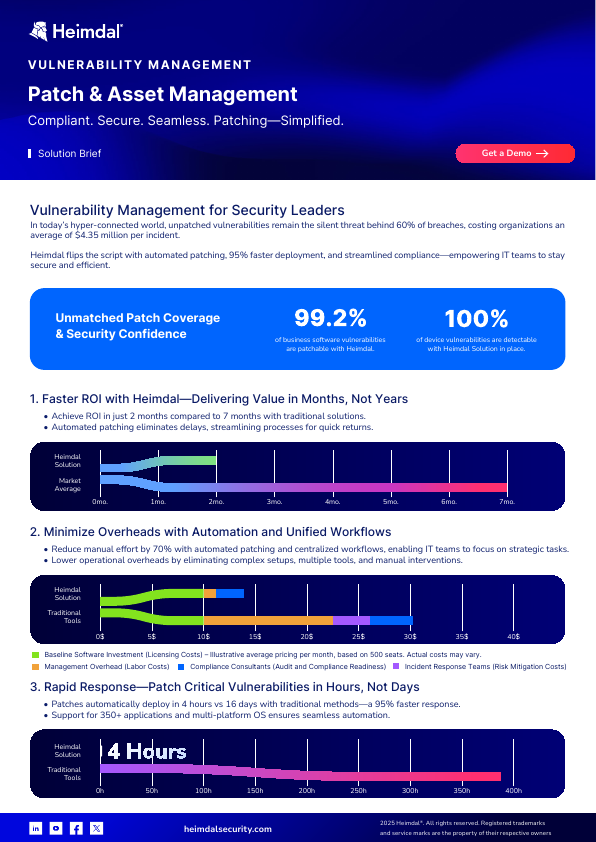
"Automates the deployment of operating system and application updates, helping organisations reduce vulnerability exposure and maintain secure, up-to-date endpoints."

Centralised patch deployment and asset inventory for managed endpoints
Many organisations struggle with inconsistent patching and incomplete asset records. That situation increases exposure to known vulnerabilities, complicates licence tracking and wastes technician time. It is more acute where staff are small, endpoints are remote and estates are mixed across sites and platforms.
Heimdal Patch and Asset Management gives a single place to push updates and to record hardware and installed software. It reduces the need for manual reconciliation and makes the state of managed endpoints easier to inspect and report on. The product is used alongside existing endpoint management and security tools to improve control over patching and inventory.
For regulated-sector teams, MSPs and SMEs the product is useful for producing consistent inventory data and enforcing scheduled patching across dispersed endpoints without adding full-time headcount.
Where Heimdal Patch and Asset Management is used
An MSP uses Heimdal to manage third‑party patching across several client estates, applying consistent policies and keeping consolidated inventory records to simplify billing and support.
An SME with a small IT team automates OS and application updates and uses the inventory to reconcile installed software against licences and procurement lists.
A regulated organisation deploys Heimdal across multiple sites and remote users to ensure scheduled patching and to provide demonstrable inventory data for internal checks.
Fits within these solutions
Suitable environments
Fits organisations with many endpoints, distributed sites or hybrid workforces where manual patching and asset tracking are a burden. It suits estates with mixed OS and third‑party applications.
Also appropriate where IT or security teams are small and need to reduce routine tasks. It is commonly used by MSPs and regulated-sector firms that need consistent inventory and scheduled patching across clients or sites.
Benefits
Reduce vulnerability exposure
Applies patches quickly to reduce the window of exposure to known vulnerabilities.
Improve endpoint security
Keeps systems up to date to reduce the risk of exploitation.
Automate patching processes
Reduces manual effort by automating patch deployment across endpoints.
Support compliance and audit requirements
Provides visibility and reporting to demonstrate patch compliance.
Minimise user disruption
Deploys updates in the background to avoid impacting productivity.
Increase visibility of patch status
Provides insight into missing updates and patch coverage across the organisation.
Reduce security incidents
Prevents exploitation of known vulnerabilities by keeping systems up to date.
Capabilities
Automated patch management
Third-party application patching
Operating system patching
Vulnerability remediation
Policy-based patch deployment
Centralised patch management
Reporting and compliance
Silent background updates
Applications
Automate security updates across endpoints
Used to ensure operating systems and applications are consistently patched without manual effort.
Patch third-party applications
Applies updates to commonly exploited third-party software.
Reduce vulnerability risk
Closes security gaps by applying patches as soon as they become available.
Support compliance and audit requirements
Provides reporting and visibility to demonstrate patching status.
Manage patch deployment at scale
Used to deploy updates across large numbers of endpoints in a controlled manner.
Reduce manual patching workload
Removes the need for manual update processes across systems.
How we help
Armstrong may support implementations, configure patching policies and provide ongoing product support for Heimdal Patch and Asset Management. Armstrong often helps with integrating the product into existing endpoint and security tooling, and with improving control processes around inventory and patching. Typical customers include MSPs, SMEs, multi‑site organisations, remote/hybrid workforces and regulated-sector teams. Armstrong works with internal IT teams and does not operate customer environments.